

Lahmacun is one of the most loved foods in Türkiye — thin, crispy flatbread topped with a flavorful ground meat mixture. Add parsley, onions and a squeeze of lemon, roll it up, take a bite, and the flavor speaks for itself. One bite of Turkish lahmacun and you’ll be completely obsessed.
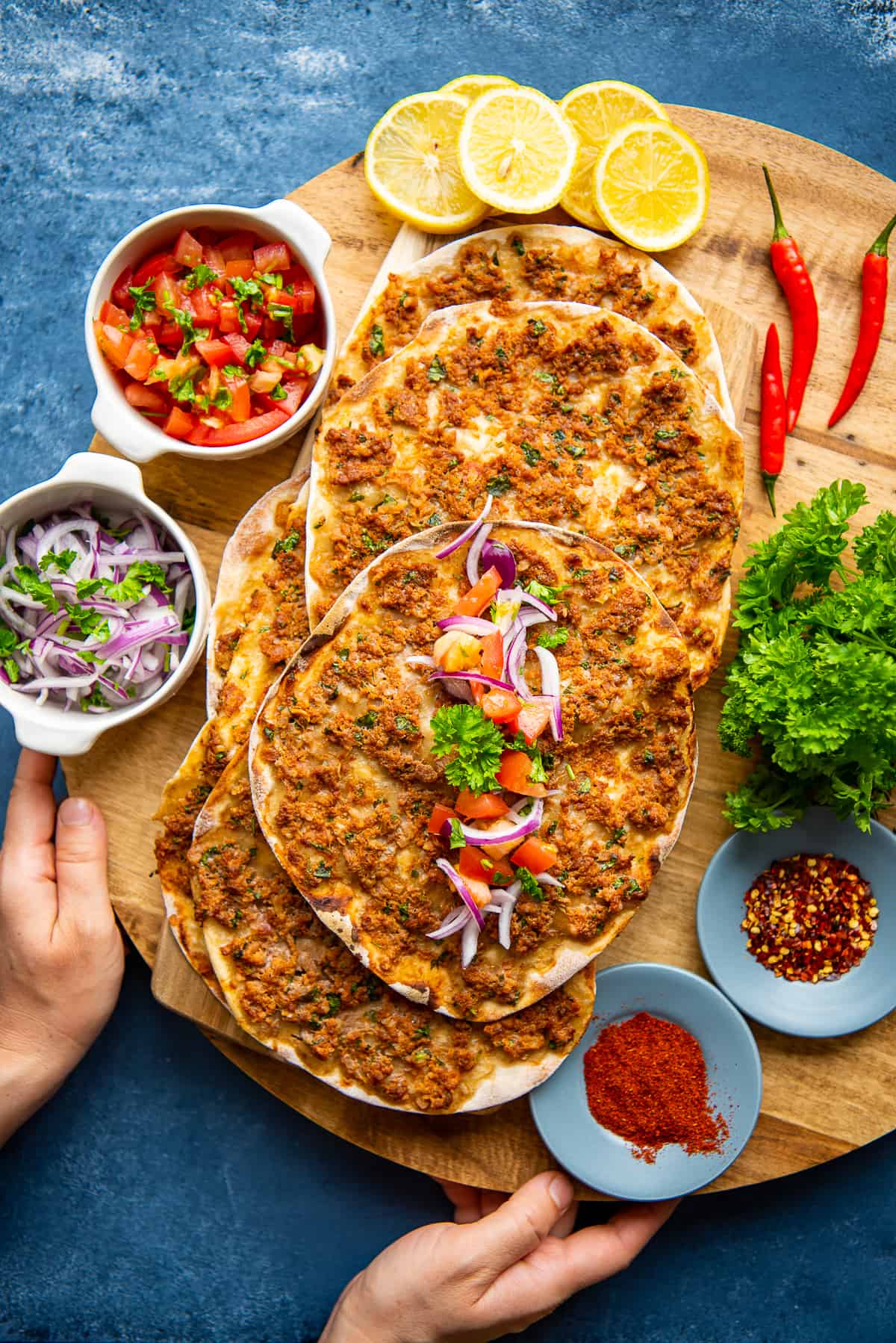
What is Lahmacun?
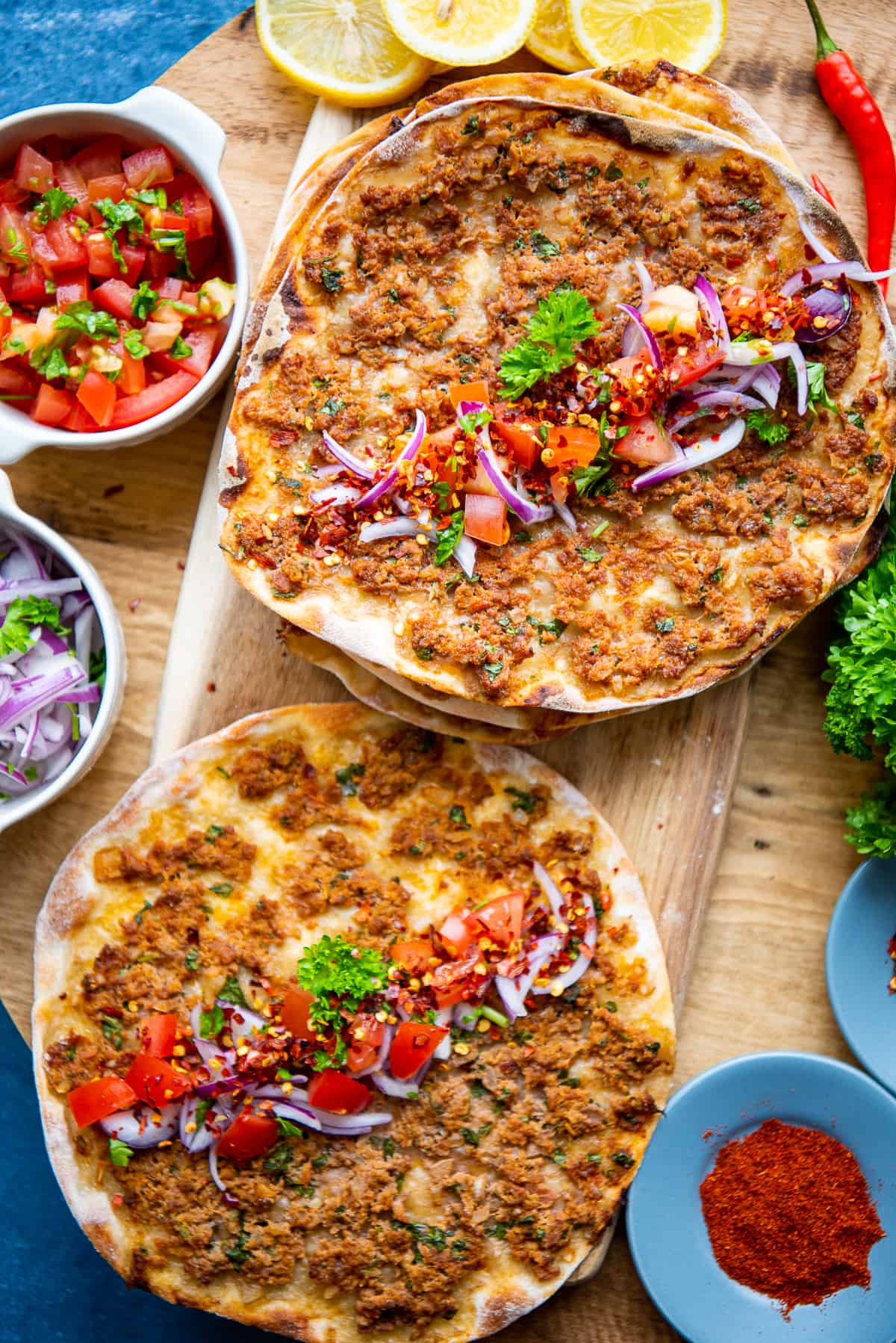
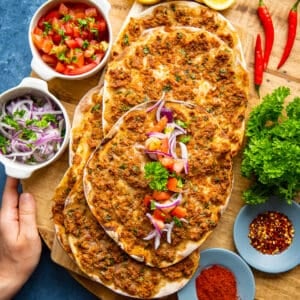
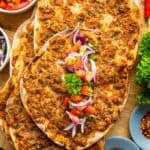
Lahmacun is a very thin flatbread topped with a mixture of ground meat, tomatoes, onions and parsley.
The dough is rolled out very thin — much thinner than pizza — and traditionally baked in a very hot stone oven (taş fırın). That high heat cooks it quickly, making the edges lightly crisp while the topping stays tender and full of flavor.
In Türkiye, lahmacun is extremely common. You can find it in neighborhood bakeries, pide restaurants and very often in kebab restaurants too. In some kebab restaurants, you might even see mini lahmacun served as a small appetizer before your main dish arrives.
When we were living in Türkiye, like many Turks, we often had lahmacun for lunch, usually with a glass of ayran (a salty yogurt drink) on the side.
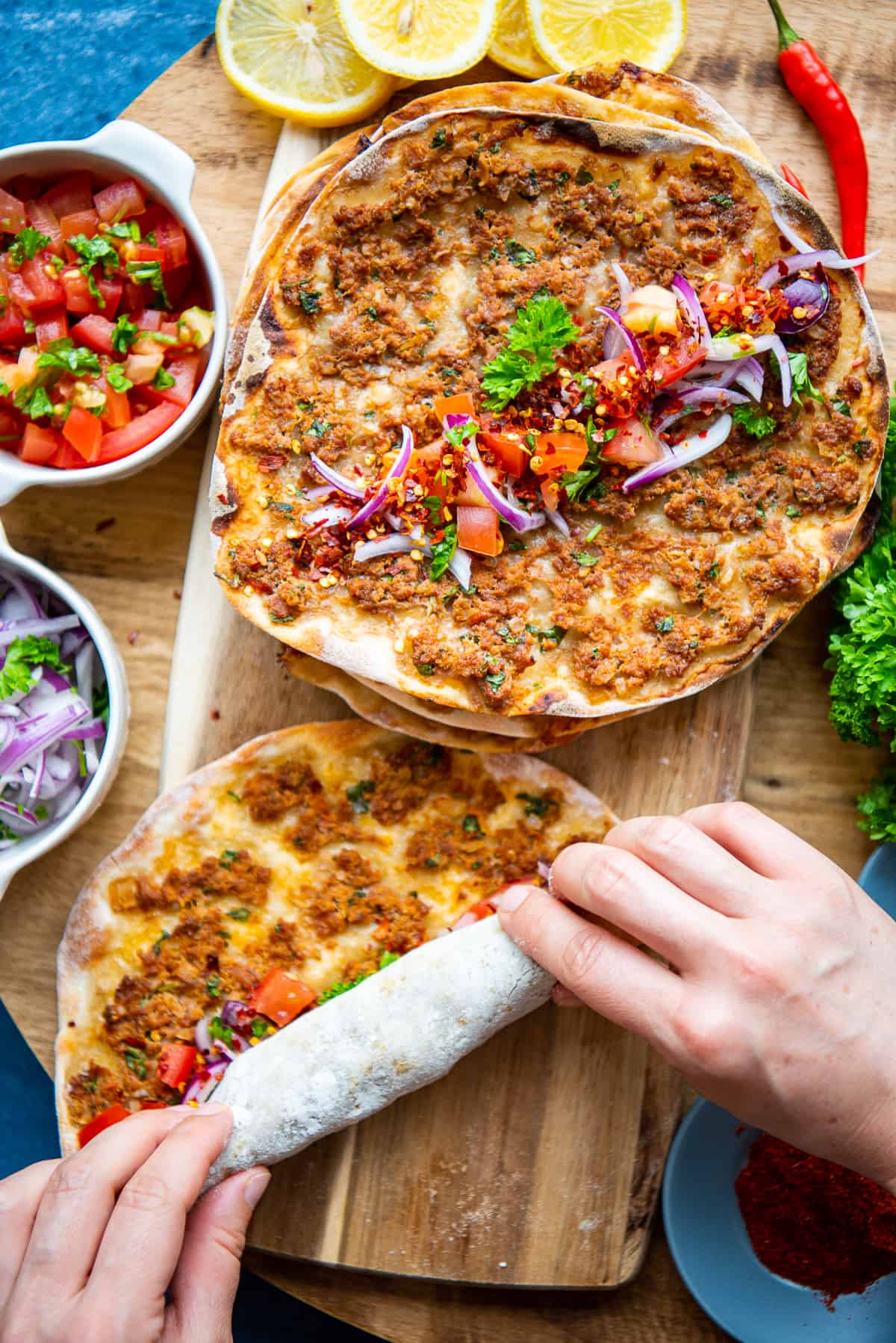
Lahmacun is almost always served with fresh parsley, thinly sliced onions and lemon wedges on the side. You add them on top, squeeze over plenty of lemon, roll it up and eat it that way.
Even describing it makes us crave one right now!
About the Ingredients
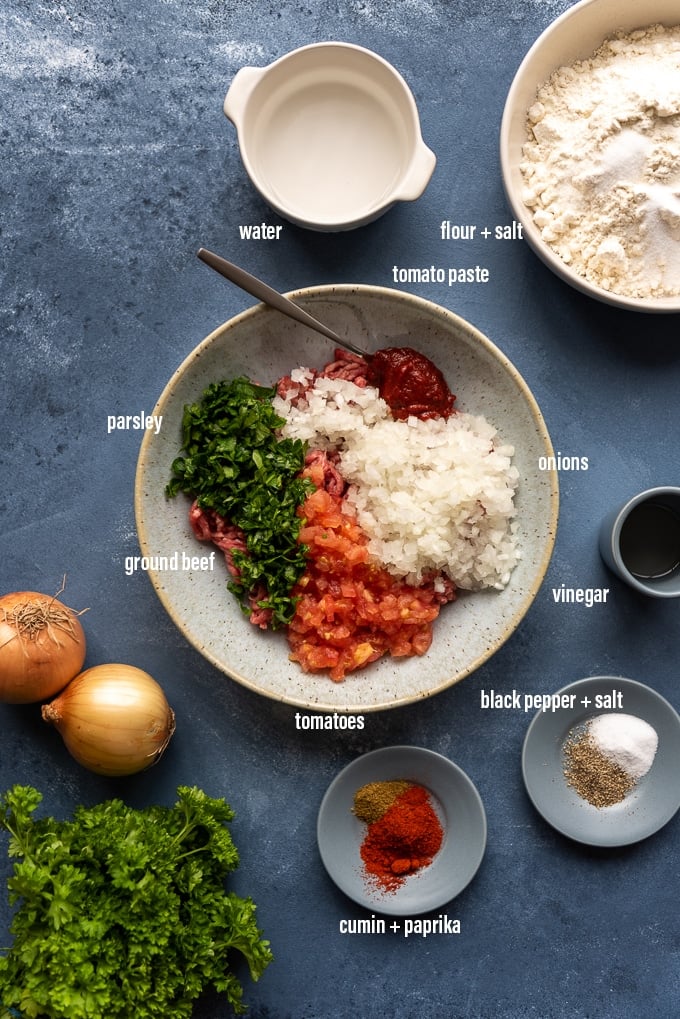
Turkish lahmacun recipe is made with very simple ingredients. Let’s look at them in two parts: the dough and the topping.
For the Dough
The dough is made with strong bread flour, salt and water. That’s it. There is no yeast in this dough. Using strong bread flour gives the dough more structure, making it easier to roll out very thin.
For the Topping
Ground meat:
Traditionally, many bakeries in Türkiye use ground lamb (lamb mince) for lahmacun. We usually make ours with fatty ground beef (around 20% fat), which still gives a juicy result.
Onion, tomatoes and parsley:
These should be very finely chopped. Use fresh tomatoes — not canned.
Spices:
We use salt, black pepper, paprika and cumin. If you like it spicy, you can also add pul biber (Turkish red pepper flakes).
Tomato paste (domates salçası) and red pepper paste (biber salçası):
These add depth and color to the topping. You can usually find both in international or online markets. For pepper paste (biber salçası), we recommend using the mild version rather than the spicy one, so you can control the heat yourself. You may also come across a product called karışık salça, which is a mix of tomato and red pepper paste — that works well too. Two well-known Turkish brands are Öncü and Bodrum.
You can find the full ingredient list with exact measurements in the recipe card below.
How to Make Turkish Lahmacun
Making Turkish lahmacun at home is much easier than it looks. It just takes a bit of planning and time.
It’s even better if you turn it into a family or friends activity. We usually make it together as a family, which makes the process easier and more fun.
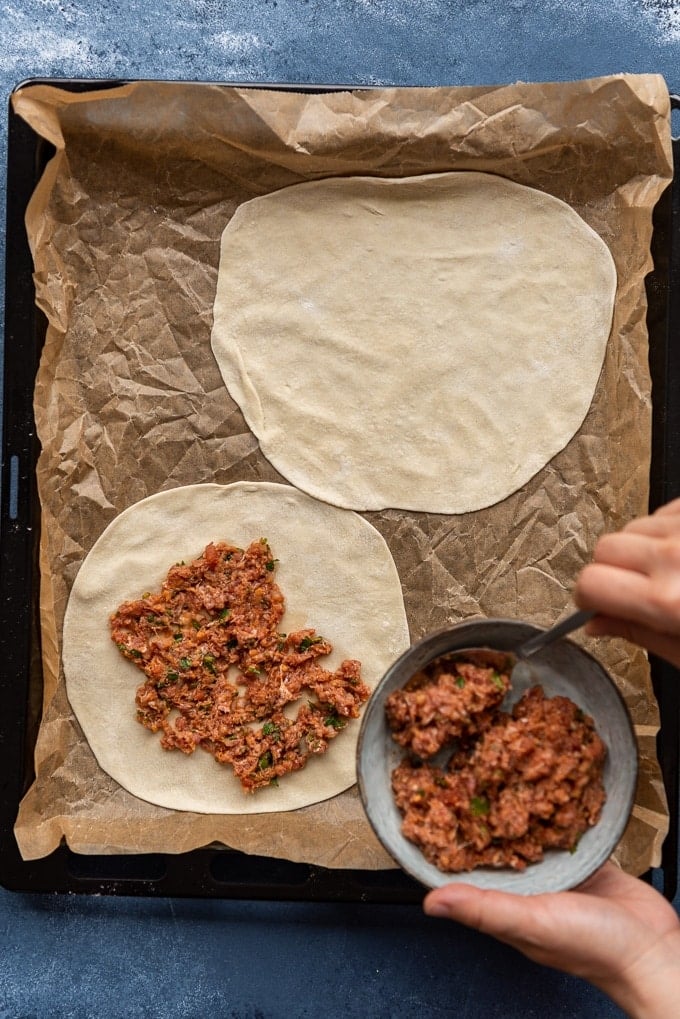
Start by preparing the dough. Mix the flour, salt and water until it comes together, then knead until smooth. Divide it into balls and let them rest while you prepare the topping.
For the topping, finely chop the onions, tomatoes and parsley, then mix them with the remaining ingredients. The mixture should be well combined, slightly wet and spreadable — not chunky.
Roll each dough ball out very thin, much thinner than pizza. Spread a thin layer of the meat mixture evenly over the surface, all the way to the edges. Bake in a very hot oven until the edges are lightly crisp and the topping is cooked through.
Once all the lahmacun are baked, there is one final step we recommend. Quickly heat each one in a hot pan for about a minute to lightly toast the bottom.
Serve warm with fresh parsley, onions and plenty of lemon on the side.
You can find the full step-by-step instructions in the recipe card below.
Serving Suggestions
Turkish Lahmacun is best served warm, with a few fresh sides that balance the rich meat topping and add brightness.
Here are some classic options:
- Thinly sliced onions or sumac onions
- Fresh parsley leaves
- Lemon wedges for squeezing generously on top
- Sliced tomatoes
- Shepherd salad (çoban salatası) on the side
- A cold glass of ayran
Also, explore our list of Turkish side dishes for more ideas.
Is Lahmacun “Turkish Pizza”?
Outside of Türkiye, lahmacun is often called “Turkish pizza.” We understand why. It’s round, topped with some mixture and baked in an oven. But that’s where the similarity ends. Lahmacun is not pizza!
For one thing, the lahmacun dough is rolled out extremely thin and baked until lightly crisp. It’s not soft and chewy like pizza dough.
And the topping is completely different too. Instead of cheese and tomato sauce, lahmacun is topped with a spiced ground meat mixture with tomatoes, onions and parsley. There is never melted cheese on top.
Another difference is how it’s eaten. You don’t slice lahmacun like pizza. You top it with fresh parsley, squeeze plenty of lemon over it, and often add thinly sliced onions. Then you roll it up and eat it like a wrap, basically turning it into a simple lahmacun wrap.
Also, lahmacun isn’t always round. Depending on the bakery, it can sometimes be slightly oval.
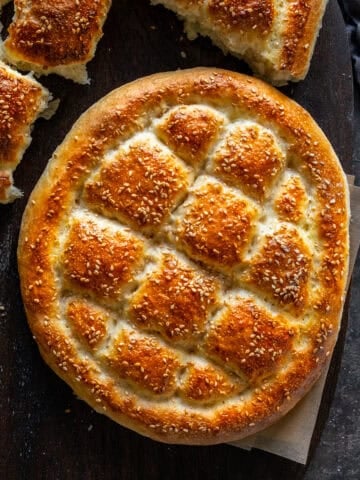
If you’re looking for something in Turkish cuisine that feels closer to pizza, that would probably be pide. It’s a boat-shaped flatbread that is topped with meat, cheese or vegetables, and its thicker dough makes it more similar in texture to pizza.
Is Lahmacun Turkish?
Lahmacun is very popular in Türkiye, but it is not only made there. Similar flatbreads topped with minced meat can also be found in Armenian, Lebanese, Syrian and other Middle Eastern cuisines.
Since these countries are close to each other and were historically connected, including during the Ottoman Empire period, it’s natural that their cuisines share similar dishes like this one. However, each version is a little different. The thickness of the dough, how crispy it is, the spice level, and even the texture of the topping can vary from place to place.
Here, we’re sharing the Turkish version of lahmacun, the one we know best.
Storing and Reheating
If you have leftovers, let the lahmacun cool completely before storing. Keep them in an airtight container in the fridge for up to 3 days. You can place parchment paper between them to prevent sticking.
To reheat, put each lahmacun in a dry pan and warm over medium heat for a few minutes until heated through. You can also reheat them in a preheated oven at 180°C (350°F) for about 5–7 minutes.
If you’d like to freeze them, place parchment paper between each lahmacun, stack, and store in a freezer-safe bag or container. Reheat straight from frozen in a preheated oven at 180°C (350°F) until hot and crisp.
More Turkish Recipes
Sign up for the FREE Give Recipe Newsletter to get the new recipes into your inbox!
And stay in touch with us on Facebook, Pinterest, YouTube and Instagram for all the latest updates.
📖 Recipe
Turkish Lahmacun Recipe
Video
INGREDIENTS
Dough
- 3 cups (450 g) strong bread flour, plus more for rolling (All-purpose flour or plain flour works fine too, but we’ve found that strong bread flour gives the best results.)
- 1 teaspoon salt
- 1 cup (240 ml) lukewarm water
Topping
- 1½ pounds (750 g) ground beef (80% lean / 20% fat)
- 2 large onions finely chopped
- ½ cup about 3 medium tomatoes, peeled and finely chopped
- ¼ cup finely chopped parsley
- 2 tablespoons tomato paste
- 1 tablespoon red pepper paste (biber salçası)
- 1 teaspoon salt
- 1 teaspoon black pepper
- 1 teaspoon paprika
- ¼ teaspoon ground cumin
- 1 tablespoon vinegar
- 2 tablespoons water
- ⅓ cup (100 ml )olive oil
INSTRUCTIONS
- Preheat the oven to 450°F (230°C). Cut two pieces of parchment paper the size of your baking sheet. Line the baking sheet with one and set the other aside.
Make the Dough
- In a large bowl, whisk together the flour and salt.
- Gradually add the lukewarm water, mixing with your hand until the dough comes together. At first, it may seem dry, but continue mixing and folding. The dough will come together into a firm, smooth ball.
- Knead for 5–7 minutes until smooth and elastic.
- Divide the dough into 10 equal pieces (about 65–70 g / 2.3–2.5 oz each). Roll each piece into a ball and place on a lightly floured surface. Cover with a clean kitchen towel and let rest while you prepare the topping.
Prepare the Topping
- In a large bowl, combine all topping ingredients and mix very well until fully incorporated.
- Alternatively, pulse the onions, tomatoes, pepper paste, tomato paste, vinegar, water and olive oil in a food processor until finely minced. Transfer to a bowl and mix with the ground beef, parsley and spices.
Assemble & Bake
- Roll out one dough ball on a lightly floured surface into a very thin circle, about 8–10 inches (20–25 cm) in diameter. Lightly flour as needed to prevent sticking.
- Transfer to the prepared baking sheet.
- Spread a thin layer of the topping evenly over the dough, making sure to cover all the way to the edges. Gently press the mixture onto the dough so it adheres well.
- Bake for 7–8 minutes.
- While it bakes, roll out the next dough ball on the reserved parchment paper and spread the topping evenly over it so it’s ready to transfer.
- Remove the baked lahmacun from the oven and place it on a cooling rack. Set the used parchment paper aside to reuse for the next batch.
- Carefully transfer the prepared lahmacun (with its parchment) onto the baking sheet and continue baking in batches.
- Replace the parchment paper with a fresh sheet after every 2–3 batches, if needed.
Pan Finish for Best Results (Recommended)
- For a more authentic texture with light brown spots on the bottom, heat a large non-stick pan over high heat.
- Place each baked lahmacun in the hot pan for about 1 minute to lightly toast the bottom.
- Stack them on a plate and serve warm with lemon wedges, parsley and sliced onion on the side.
NOTES
Heat a non-stick pan with a lid over medium-low heat. Roll out a dough ball on a lightly floured surface into a thin circle that fits your pan. Carefully place it in the hot pan. Spread the topping mixture over the dough using a spoon and gently press it down with the back of the spoon. Cover with the lid and cook for 7–8 minutes, or until the bottom develops light brown spots. Repeat with the remaining dough balls. If you prefer, you can spread the topping over the dough while it’s still on the counter and then carefully transfer it to the pan. However, this can be a bit tricky, as the dough becomes harder to move once topped. That’s why we find it easier to place the dough in the pan first and then spread the topping inside the pan.
NUTRITION
Nutrition information is automatically calculated, so should only be used as an approximation.
Zuber Ismail Hatia says
Hi. Thank you for this very detailed recipe. Just one question: do you not proof/rest the dough (for an hour or so) and then form individual balls and rest again before attempting to roll flat?
Zerrin & Yusuf says
Hi Zuber,
Thank you for your question! There’s no yeast in our lahmacun dough, so it doesn’t need to proof for an hour. We divide the dough into individual balls, cover them with a clean kitchen towel, and let them rest while we prepare the topping. That resting time is enough to relax the dough and make it easier to roll out very thin.
G.F says
I've made it and I love it. Even my turkish fried said it was sooo delicious. I love your recipes. Everything is clear and the food is so delicious.
Zerrin & Yusuf says
Thank you so much for your kind words — we’re really happy to hear that you loved it. And getting a thumbs-up from a Turkish friend makes it even more special for us. Thanks for coming back and leaving a comment and a five-star rating 🙂
Tea says
Just stopping by to say i tried your recipe and got rave reviews from people at the table.
I used ground turkey, which I know isn't ideal, but I intuitively put some olive oil in the mixture to compensate for the richness, having only later noticed that you gave this recommendation in the blog post! 🙂
Zerrin & Yusuf says
Hi Tea, so glad you stopped by to share this! Ground turkey with olive oil is such a smart swap. We love that you followed your intuition (and then saw our tip too 😄). Thrilled to hear it got rave reviews at your table!
Connie says
Excellent
Richard Sherrington says
How many grams is your 3 cups of flour?
jo hall says
I loved the recipe, but my base was crispy and wouldn't fold by the time it was cooked. Is it meant to be brown on the bottom?
Zerrin & Yusuf says
Hi Jo,
We are glad you liked the recipe!
The base should be slightly crisp but still flexible enough to fold. There are two reasons why your base might have been too crispy. First, it could have been in the oven too long. Try baking it for a shorter time or at a lower temperature next time. Second, if they sit out for a while after baking, they can become crispier. If you're not serving them right away, you can keep them softer by placing them on a plate and covering them with a clean kitchen towel.
As for their bottom, there could be brown spots and that's ok.
Martie says
I made these using corn tortillas as I was short of time. They were delicious although they did not roll well. I look forward to making the flat bread from scratch and I will increase the spices next time. Thank you for a quick, yummy meal.
Zerrin & Yusuf says
Hi Martie,
Thank you for the comment and five-star rating! We have used flour tortillas as a shortcut before and they were good. Maybe you can try them next time when you need a shortcut. Can't wait to hear what you think when you make lahmacun from scratch!
Anita says
I just want to clarify, that the meat is raw when you put it on the flatbread; along with the other ingredients?
Zerrin & Yusuf says
Hi Anita!
Yes, it is raw. Don't worry, it cooks with the other ingredients on the dough.
Recipe land says
Thanks for sharing this recipe
Marie says
Thanks for sharing your recipes. I have always loved Mediterranean and Persian food, so I recently decided to try Turkish cuisine. On a recent trip to Houston we drove by a Turkish restaurant and decided to give it a try. The first thing we tried was this lahmacun. So delicious! We tried several other things and absolutely loved it all. We also enjoyed the warm and caring people who worked in the restaurant. I love Turkish food so much that I have made several dishes since then and have several Turkish spice blends that I keep on hand. I am so glad I found your website and look forward to trying out many of your recipes!
Zerrin & Yusuf says
Hi Marie,
We're thrilled to hear about your love for Turkish cuisine and your positive experience at the Turkish restaurant. Lahmacun is indeed a delightful dish! We're so happy you enjoyed it, and even happier that you're enthusiastic about trying out more recipes from our website.
Having Turkish spice blends handy can really level up your home cooking! We're excited to see what you'll whip up next. Don't hesitate to share your culinary adventures with us, we'd love to see your takes on the recipes.
Thank you for your kind words, and happy cooking!
Saima says
Checking the recipe to make these again. I make 4 at a time in the oven on silicone oven tray liners or on my pizza stone. So delicious.
Zerrin & Yusuf says
Hi Saima,
Thank you for the tip and for the 5-star rating 🙂 Have a lovely day!
Dale Waddington says
Hi Guys,
I have yet to try this recipe but have had success with others and I look forward to more! A general request... Can you please list your ingredients in grams as well as 'cups'. Cups of flour are meaningless as a quantity as the bulk density can vary so much. By all means keep the cups for our American friends but please also include the metric equivalent.
Thank you.
Zerrin & Yusuf says
Hi Dale,
A good heads up! We will keep this in mind. It is not possible to add the gram measurements in all the recipes overnight, but we will do it. Thanks!
Sandy says
Thank you for taking the time to share your recipe. People can easily look online for conversions to grams…thanks again
Sandy says
Google is your friend!
Quentin says
Good morning, I am about to try your Lahmacun. You say to mix all ingredients for the topping together but the photographs appear to show the onion, tomatoes and parsley placed on top after cooking. Which is the prefered please? Kind regards Quentin
Zerrin & Yusuf says
Hi Quentin,
Thank you for your question. Yes, mix everything well for the topping as the recipe says.
In the photographs, you see how lahmacun is traditionally served. With side dishes like a simple tomato salad, sliced onions and extra parsley. These three sides always come together at any authentic lahmacun restaurant. Lemon wedges also accompany these. We always squeeze lemon on lahmacun, put some parsley (almost a must) and a little salad or onion slices (optional) on it and make a wrap. This is how lahmacun is eaten in Turkey and we highly recommend eating it this way.
Quentin says
Thank you for your very prompt response, I am humbled.Can I please ask if a sprinkling of bahrat would take anything away from this dish please.
Zerrin & Yusuf says
You are welcome! Baharat is traditionally not used in Turkish style lahmacun. But we always think you can get creative and make your own twist on recipes. Would love to know what you think when you make the recipe.
Cheers!